
What Lee County Property Tax Records Show
Lee County property tax records stack several numbers on one parcel. Each label means something different. There is the appraised market estimate, the classified assessed value, any exemptions, the district charges, the billed amount, and finally the payment status. Blurring them together causes most reading errors. The Revenue Commissioner handles appraisal, assessment, collection, and the public lookup. Alabama law sets the classification formula behind the figures.
| Field | What It Shows | Where |
|---|---|---|
| Market or appraised value | County estimate before classification | CAMA appraisal fields |
| Assessed value | Class percentage applied to value | Assessment record |
| Land / building / improvement | Separate value components | Land, Bldg, and Imp tabs |
| Exemption | Relief coded to a qualifying parcel | CAMA and Revenue office |
| Tax bill / status | Amount, year, and paid or delinquent state | Taxpayer search and pay |
| District or city charge | Jurisdiction-specific levy | Tax record or delinquent list |
A tax value is never a sale price. Alabama first applies the property's classification percentage to fair market or current-use value. Then millage rates and exemptions produce the actual taxable liability.
Search Lee Revenue by Year and Terms
The official Lee property form exposes year and search controls.
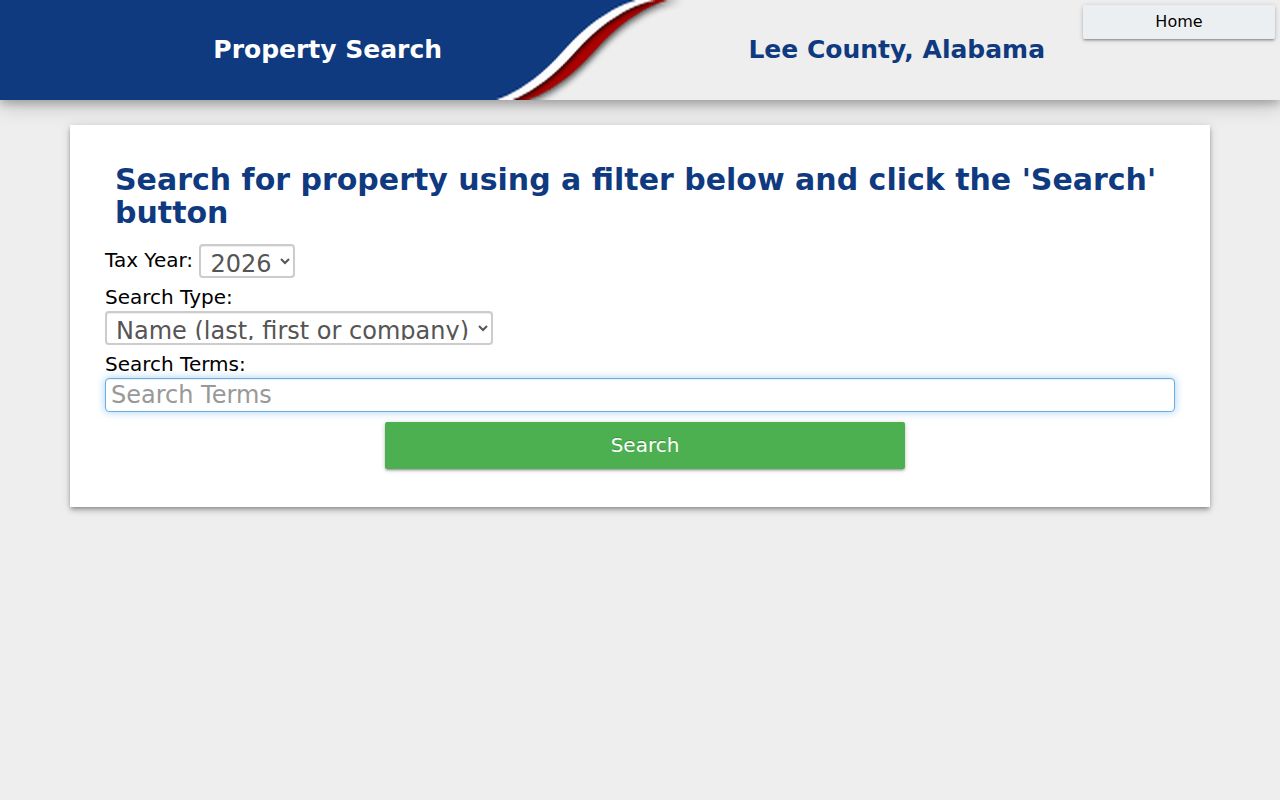
The official lookup page deserves a careful first step. Verify the selected year before reading any result.
The Lee property form lists Tax Year, Search Type, Search Terms, Subdivision, and Search in that order. The form does not publish its wildcard rules, option lists, result limits, or year coverage. So write down the year you searched. A blank result does not mean the parcel has no tax record at all.
| Control | What to retain | Reason |
|---|---|---|
| Tax Year | Exact selected year | Values and status change annually |
| Search Type | Owner, parcel, or other displayed choice | Defines how terms are interpreted |
| Search Terms | Raw text and variants | Makes a failed search reproducible |
| Subdivision | Exact phase or part label | Separates similarly named developments |
Calculate Alabama Assessed Value
Alabama sorts property into classes, and each class carries its own percentage. Class I utility property is assessed at 30 percent. Class II, the catch-all for property not otherwise classified, sits at 20 percent. Class III covers agricultural and forest land. It also includes owner-occupied residential property and historic property at 10 percent. Class IV, private passenger automobiles and certain pickup trucks, is assessed at 15 percent. A qualifying homestead residence normally falls in the 10 percent real-property class. It stays out of the 20 percent class.
Apply the right class to fair market or approved current-use value first. Then bring in the parcel's actual millage and exemptions. Never estimate a bill from value alone while district and exemption data are missing.
Looking Up a Lee County Tax Bill
For the bill itself, use the Revenue taxpayer search-and-pay route. Lee CAMA is the better tool for parcel identity and the valuation components. One caution applies. The county warns that displayed values may be dated. Values can shift before finalization.
- Choose the tax year and search by the strongest available owner or parcel term.
- Match PIN/PPIN, physical address, legal description, and district.
- Record land, building, improvement, market, assessed, exemption, and tax fields separately.
- Confirm paid or delinquent status and preserve the access date.
- If a sale notice appears, verify decree, advertising, sale, redemption, and later deed status independently.
- Assessed value
- The classified portion used in tax calculation.
- Millage
- The levy applied per thousand dollars of assessed value.
- Homestead exemption
- Qualified owner-occupant relief that must be claimed and maintained.
- Tax lien
- The public claim arising from unpaid property tax, distinct from a deed.
Track the Lee Tax Calendar
County materials put taxes due on October 1, with delinquency following on January 1. From there the timeline moves fast. A decree of sale comes in February. Advertising runs in March. The annual tax sale lands in May.
Each stage creates its own record. A delinquent line does not prove an advertised sale happened. An advertised sale does not prove title transferred, either. The 2025 operational notice set a May 6 sale with April 30 registration. Those dates are history, not a repeating schedule. Check the current Revenue notice for your parcel and tax year.
Read a Delinquent Listing Carefully
Lee's published 2023 delinquency list, issued in 2024, is dense with fields. It lists owner, formatted parcel, PPIN, legal description, subdivision or plat, state and county charges, fees, interest, and a total. Some entries break out City of Auburn charges separately. That city line teaches a broader lesson. Postal place, municipal boundary, tax district, and county location are four different things.
Keep the publication date and every charge category intact when you copy an entry. Then verify later payment, sale, certificate, redemption, assignment, tax deed, and Probate recording. Do this before drawing any conclusion. Never treat the listing as proof of current ownership.
Handle a Prior Owner’s Tax Bill
Lee County says it plainly. The current owner stays responsible for the bill. That holds even when it still bears a former owner's name. To sort out a mismatch, compare the current deed's recording date, the CAMA owner, the assessment date, the tax-notice name, and the exemption filing. Do this side by side. Timing lags explain many gaps. Others point to the wrong parcel or an incomplete deed chain.
Label any tax-roll observation with its year. Confirm recorded ownership through Probate rather than turning a bill name into a title conclusion.
Claim and Maintain Homestead Relief
County guidance sets the homestead rules. Occupants named on the deed must occupy the qualifying residence. They must live there on October 1. They must also file before December 31 of the purchase year. A deed or occupancy change can trigger a new filing. Additions and modifications should be reported as well. Elderly, disability, blindness, and other relief programs carry their own eligibility rules. Confirm them with Lee Revenue directly. Bring the recorded deed and parcel identifiers when you ask. An online classification code alone does not prove every requirement is still satisfied.
A purchase near the annual assessment transition generates dates that must never be blended. Closing, deed execution, deed recording, October 1 occupancy, and the exemption filing each stand alone. The December 31 cutoff, tax-year selection, and the eventual bill do too. Save the notice and the Revenue response with your parcel record. If spouses, co-owners, a trust, or an estate are involved, ask the office which deed and occupancy evidence applies. A shared surname proves nothing about eligibility.
Appealing a Lee County Assessment
A written value protest goes to the Lee County Board of Equalization. Mail it to PO Box 3050, Opelika, AL 36803-3050. Build the case with the valuation notice, correct parcel identity, property condition, comparable evidence, and photographs. Add any relevant appraisal material and a clear explanation of the disputed field.
The board meets in spring and early summer under county guidance. Ask which evidence format, appointment procedure, and parcel-year record apply to the current cycle. Keep proof of mailing and the final notification. Both dates shape the next deadline.
Appeal window. The written protest must be postmarked within 30 days of the Notice of Valuation. A Circuit Court appeal must be made within 30 days of final board notification, with current tax-payment or bond rules checked before filing.
Apply the 7 Percent Cap with Caution
Act 2024-344 caps certain year-to-year increases in taxable assessed value at 7 percent for qualifying Class II and Class III real property. Statutory conditions apply. The Department of Revenue defines true assessed value. It equals fair market or current-use value multiplied by the classification percentage. That formula drives everything downstream. It is where any Lee County property tax records audit should begin.
Treat the cap as a ceiling, not a forecast. Ownership changes, improvements, reclassification, exemption adjustments, millage, and statutory exceptions can all move the final figure. Lean on the county's parcel-specific calculation and current state guidance rather than assumptions.
To audit a change, set the prior and current tax years side by side. Record fair market or current-use value, classification, true assessed value, exemption, district, millage, and taxable amount. Note any improvement or ownership change too. Then ask Lee Revenue which statutory condition and effective year controlled the calculation. Comparing only the final bill can hide the real driver. The difference may come from valuation, classification, exemption, or levy.
Keep the county notice, the CAMA record, and the calculation for each year. A later revaluation endpoint may expose Sale, Flag, or Mapr tabs. The county publishes no confirmation that it serves as the production tax roll. Use the taxpayer search and the Revenue office. Confirm which record is official for the disputed year.