
Lee County Deed Records and What They Show
Every conveyance the Judge of Probate accepts becomes part of the deed records for Lee County. Recording is what makes it official. Each instrument ties named parties to a legal description. It also carries execution and recording dates and a book-and-page reference. Begin with the instrument type. Deeds carry different warranties and can come from a sale, an estate, a correction, a trust, or a tax proceeding. The type shapes what the document proves.
| Deed Type | What It Does | Common Use |
|---|---|---|
| Warranty deed | Conveys stated land with deed warranties | Ordinary sale |
| Quitclaim deed | Conveys whatever interest the grantor holds | Family transfer or cleanup |
| Corrective deed | Corrects an earlier instrument | Name or description correction |
| Executor deed | Conveys through estate authority | Probate sale |
| Tax deed | Documents a post-tax process conveyance | Delinquent-tax proceeding |
A deed transfers an interest in land. That is its job. A mortgage, judgment, lien, assignment, release, or lis pendens can affect the same interest without being a deed of ownership at all. Search those related instruments too. Just remember that a mortgage on record proves neither present title nor current debt.
Begin at the Opelika Viewing Stations
All deeds are recorded through Lee Probate at 215 South 9th Street, Opelika, AL 36801. Public viewing stations are the verified access route. Staff can locate a deed by name for an in-person requester. Bring owner name variants, an approximate date, a PIN or PPIN, legal-description clues, and any deed book or page pulled from CAMA. The county publishes no official remote grantor-grantee index and states no earliest online coverage year. A Revenue deed reference works as a discovery lead only. It never substitutes for the recorded page. Call 334-745-9761 before traveling to confirm hours and retrieval of older volumes.
Capture Every Deed Reference
| Index or deed field | Research purpose |
|---|---|
| Grantor / grantee | Connects transferor and recipient |
| Book, page, recording date | Returns to the recorded item |
| Execution date | Separates signing from recording |
| Legal description | Matches the actual land |
| Plat or prior-deed reference | Follows splits, phases, and earlier conveyances |
| Consideration / validation | Provides transfer context, not necessarily market value |
Names alone cannot join two deeds. Compare the description, subdivision phase, lot, acreage, dates, and cross-references before extending any chain one link further.
The Lee County Grantor-Grantee Index
A grantor conveys the interest. A grantee receives it. Build a backward chain from the latest confirmed acquisition deed, then hunt for the deed by which that same grantor first acquired the same land in Lee County.
- Find the assessment owner, identifier, and book/page in Lee CAMA.
- Inspect that grantee’s acquisition deed at Probate.
- Record its grantor, dates, cross-references, and complete description.
- Search that grantor as an earlier grantee and repeat, resolving description changes.
- Grantor
- The party conveying an interest.
- Grantee
- The party receiving it.
- Chain of title
- The linked sequence of conveyances for the same land.
- Book and page
- The Lee reference emphasized in county copy instructions; no separate public instrument-number practice was verified.
Follow Plats and Description Changes
A deed may cite a subdivision, phase, part, lot, plat book and page, section-township-range, acreage, easement, or metes-and-bounds calls. Keep the exact wording. Lee records use phase and part distinctions. Dropping them can stitch the wrong parcels together. For a split or combination, connect each new description back to the parent deed and the recorded plat. The CAMA polygon helps you get oriented. It is not the legal boundary; a surveyor gives the boundary opinion.
Take the Chain into the Archives
The ADAH County Records search organizes microfilm by county and record type.
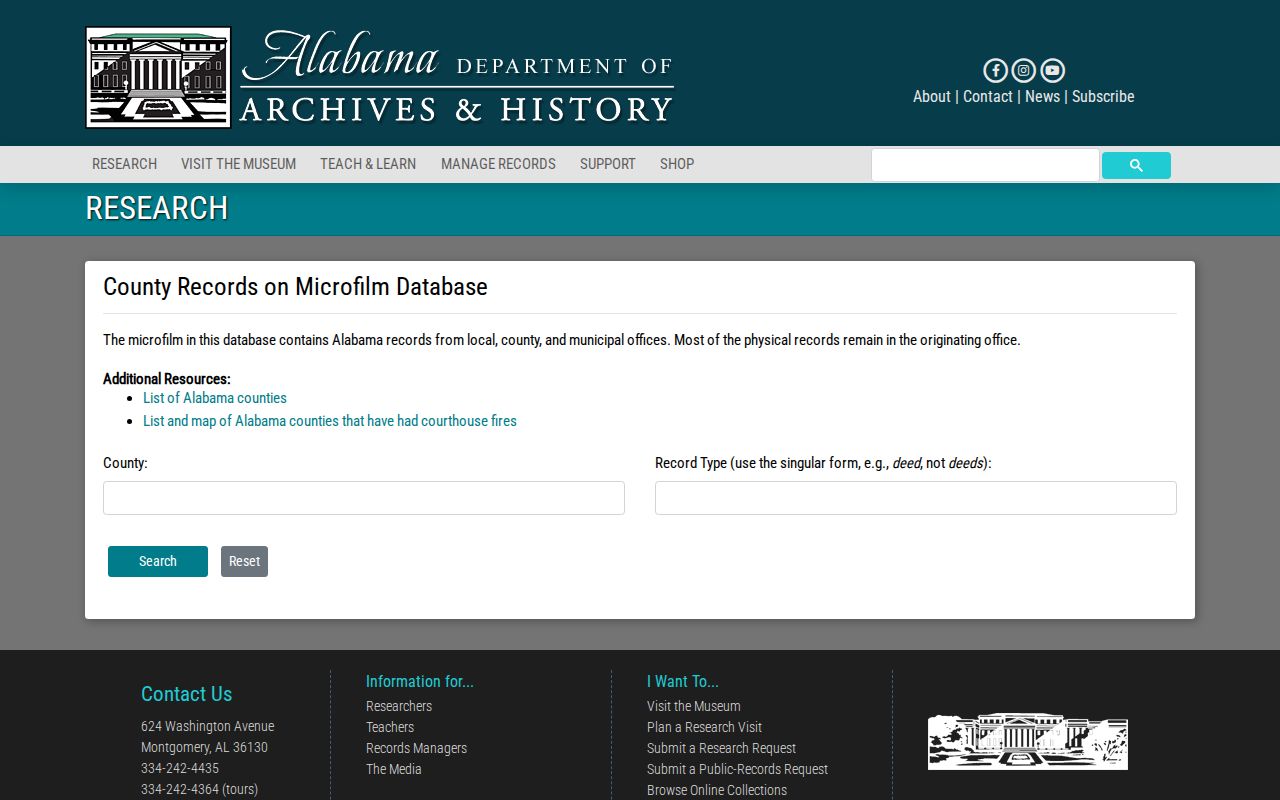
The Alabama Department of Archives and History runs a county-record portal. It identifies microfilm by county and record type. Historic deeds, wills, estates, guardianships, and plats may appear in its finding tools. Original custody, though, generally stays with the county. A finding tool points toward holdings. It does not promise an online deed image.
One digitized Lee WPA township map covers Township 17 North, Range 27 East. It draws on 1936 data derived from county probate records. It includes a property-owner list. That makes it an unusually strong map-to-name lead. Verify anything it suggests in the deed books before connecting it to a modern parcel. The archive request service is built for focused work. It allows one surname and up to four sources per its instructions.
Resolve Estates, Courts, and Tax Sales
A will or estate order can explain who had authority without being the final conveyance. Ask Probate for the estate case. Ask also for the sale order, the distribution, and any later deed-out reference. For foreclosure, quiet title, partition, boundary, or lien enforcement, inspect the Circuit Clerk file first. Then check whether a judgment, lis pendens, release, or later deed ever reached Probate.
A tax certificate, an assignment, and a tax deed are three different things. Alabama DOR warns that tax-sale documents do not by themselves create clear title. Trace redemption and every recorded instrument that follows.
Handle an estate as a sequence of separate events. Start with the death date, the case opening, and the will or administration. Follow with the sale authority, the final distribution, and the deed execution. End with the deed recording and the Revenue owner update. A will can name beneficiaries without serving as the recorded transfer. A death certificate confirms an event but names no title holders. Ask whether the estate file holds a legal description, inventory, appraisal, order, or deed reference. Do not assume every file matches.
A Lee civil case request should identify the likely parties and the date range. Include a case number if known, the parcel or legal description, and the exact filing sought. The Circuit Clerk's copy form describes a seven-working-day process. It lists a $25 base charge covering one through twenty pages. Add fifty cents per additional page and five dollars for certification. A separate $25 fee applies to an archive, paper, or history search. Confirm current terms before requesting a complete file.
Getting a Copy of a Lee County Deed
Request a plain or certified copy in person or by mail. Written requests should give the book and page plus the recording date whenever known. Mail routes to PO Box 2266, Opelika, AL 36803-2266. Probate publishes no accessible current copy-fee table. Ask about per-page costs, certification, payment, and turnaround directly. Specify whether you need every page, exhibit, acknowledgment, and attached legal description. A single index entry or first page can omit needed details. It may leave out the description or cross-reference needed to match the parcel. Keep the certification status with your copy. A downloaded or photographed image is not a certified one.
Recorded, not guaranteed. Recording gives notice of an accepted instrument. It does not prove that the grantor held every interest, locate unrecorded claims, establish a surveyed boundary, or supply a legal title opinion.
Preserve a Reproducible Deed Log
Keep a full log for every deed you handle. Note the source, access date, and exact name spelling. Also record party role, book and page, execution and recording dates, deed type, legal description, parcel identifiers, plat references, and certification status. Mark an item RECORDED only once you have reviewed the instrument itself or a certified filing. An archive index or map name stays ARCHIVAL-LEAD until the original land record closes the link.
Lee County dates to 1866. Its land history runs through Probate, Revenue, the courts, municipalities, and ADAH. Keeping those sources distinct matters. Without that discipline, a modern tax owner, a historic map name, and a deed grantee get treated as equivalent proof when they are not.
Record unresolved links instead of hiding them. A missing prior deed can stem from a name variant or an estate transfer. It can also stem from an entity merger, a corrective instrument, or a description change. So can an unsearched date span or an older volume that needs staff retrieval. Log every index and book examined. Note the spelling and date range used, plus the next source you plan to check. That negative-search history spares the next researcher the same narrow query.
Historic maps, newspapers, city directories, cemetery records, and local-history collections can explain a place name or family connection. They should support the recorded chain, never replace it. Work in order: deed and plat first. Then a dated tax record, municipal permit or plan, court or estate filing, and finally the archival lead. When sources conflict, present their dates and claims separately until an original instrument settles the question.