
Trace Lee County Owners Backward
Deeds are the primary evidence, and Lee Probate is the office that records them. The county publishes no online grantor-grantee index. That gap shapes any responsible timeline, so state it plainly rather than guessing at an earliest year.
| Source | Years It Covers | Where Held | What It Shows |
|---|---|---|---|
| Current deed | Latest confirmed transfer | Lee Probate | Grantee and prior grantor |
| Older deed books | Coverage not verified | Probate station or copy request | Earlier transfers |
| Historic plats | Varies by subdivision | Probate and ADAH | Lot, phase, and map continuity |
| WPA owner map | 1936 source data | ADAH digital item | Historic owner lead only |
In every era, the hunt starts with the deed itself. When the courthouse trail reaches older volumes, the ADAH county-record search helps you locate microfilm descriptions of Lee County deed books and related records.
Lee Probate Holds the Deed Trail
The Judge of Probate records every Lee County deed. The office sits at 215 South 9th Street in Opelika. Research happens at courthouse viewing stations. Staff can locate a deed by name for a visitor who comes in person. Copies can be requested at the counter or by mail. Bring exact name variants, an approximate recording date, and the CAMA book and page when you have them. The county offers no web-based grantor-grantee index for Lee County deed records. Treat the public CAMA deed reference as a finding aid, not as the deed itself. It is also not a remote chain-of-title screen. A written request moves faster when it names the book, the page, and the recording date outright.
Previous Owners May Use New Names
Search each former owner under the exact deed spelling first. Then widen the net. Test initials, middle names, joint ownership, estate wording, trustee capacity, and business-entity punctuation. A tax roll may shorten a name that the deed gives in full. Never merge similar names without a matching legal description. When a company shows up, preserve the entity name exactly as recorded. The Alabama Secretary of State business search helps distinguish entities, but its records never prove ownership of the parcel; only the deed supplies that link.
Copies Preserve Lee Ownership Evidence
Lee County's recording schedule lists a $5 index fee, $3 per page, $1 for each additional indexed name, and $3 for every extra book and page reference. Deed and mortgage taxes follow separate calculations. Confirm the charge with Probate before ordering. A recording schedule is not always the same as a copy quote. Save the complete instrument, not just the first page. Exhibits, legal descriptions, easement language, validation forms, and plat references can appear pages deep and may be essential to keeping the prior-owner chain tied to the same land.
Reconstruct Lee County Deed Chains
Carry the same parcel identity through every transfer. A shared surname proves little on its own, while the legal description, plat, acreage, book and page cross-references, and dates are what provide real continuity in Lee County deed records.
- Use CAMA deed book/page as a lead, then obtain the current deed at Probate.
- Record its grantor, grantee, execution and recording dates, legal description, and plat reference.
- Search the grantor as a former grantee at the courthouse station and obtain that earlier deed.
- Repeat while the land description remains consistent, noting splits, combinations, estate deeds, and corrections.
- Grantor / grantee
- The party conveying an interest and the party receiving it.
- Chain of title
- The ordered sequence of recorded transfers tied to the same land.
- Legal description
- The deed language that identifies land more reliably than an old street address.
Plats Keep Former Owners on Track
A street address can change while a recorded lot and block stay stable. That is why plats matter. Copy the subdivision, phase, lot, plat book and page, acreage, section, township, and range from each deed you examine. A split or combination may change the tract. A correction or replat can do the same. The next deed may cover only part of the earlier tract. Lee CAMA accepts plat book and page entries plus survey-grid clues. Use those fields to test continuity before you inspect the recorded plat itself. A parcel polygon helps orient the property search. But it replaces neither the legal description nor a survey.
Tax Names Can Lag a Transfer
Lee County tells new owners to record the deed. The county also asks them to have the property assessed. New owners should claim any eligible exemption within the county timetable. A tax bill can stay in the previous owner's name long after closing. The current owner still bears responsibility. That local lag never justifies inserting the tax name as an extra conveyance. It does not belong anywhere in the chain. Date any tax-roll observation and compare it against the recorded instrument. Report a tax-roll owner and a recorded grantee separately when they differ. Only a deed or another valid transfer record belongs in the ownership timeline.
Estate Records Explain Broken Chains
A death can break a clean sale-to-sale sequence. So can a probate distribution, executor's deed, court order, divorce judgment, or corrective instrument. Search Lee Probate estate material and Circuit Clerk records when the deed index alone cannot explain the next grantee. The Circuit Clerk sits at the T.K. Davis Justice Center, not at the Probate deed counter. Use a court or estate record as evidence of the event it documents. Then return to the recorded land instrument and its legal description. An obituary or library source can help tell people apart. It does not convey title.
Older Lee County Ownership Sources
Lee County was established in 1866. Original records generally stay with the office that created them. ADAH indexes county microfilm, maps, and newspapers for researchers reaching past the courthouse shelves. The 1936 WPA township map covers Township 17 North, Range 27 East. Its owner list, drawn from Probate data, offers names worth chasing through the deed books.
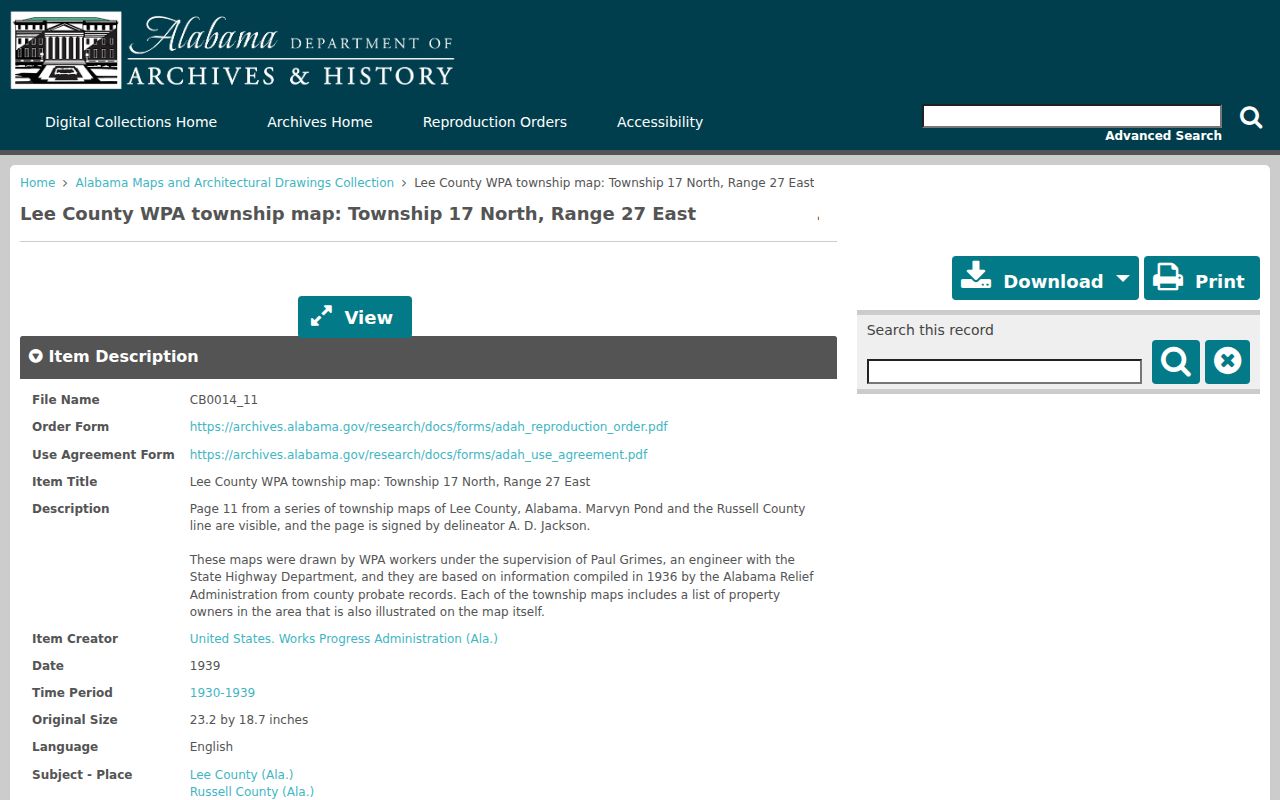
Treat a mapped name as an archival lead, nothing more. Before it joins the ownership chain, it must be connected to the recorded deed books for the same land.
- Grantor
- The party conveying an interest.
- Grantee
- The party receiving it.
- Reverse index
- An index organized to find an earlier acquisition by name.
- Quitclaim deed
- A conveyance of whatever interest the grantor has, without a warranty of title.
Coverage gap. No earliest online Lee deed year was verified. Continue through courthouse books, ADAH descriptions, and exact copy requests.
For older Lee County ownership questions, the ADAH map search is a strong starting point. It filters by county, city, period, and keyword. Results describe what the archives holds; online images are not guaranteed. A request can cover one surname, up to four sources, and 20 pages. Fees run $15 for Alabama residents and $25 out of state. Extra pages cost $0.25, and the wait is two to three weeks.
Estates can break a clean sale-to-sale chain. A will, an order, an executor's deed, or a distribution may explain the next grantee. That name may differ from the tax roll. A replat or lot combination can shift the legal description too. Keep each deed, estate event, plat reference, and tax observation in strict date order.
Lawful use. Lee County former-owner research supports house history, title research, and property diligence. Never use it to track or harass a living person.
Audit the Lee Ownership Timeline
Build a working timeline with one row for every confirmed event. Record the instrument date and recording date. Also note the grantor, grantee, deed type, book and page, legal description, plat reference, acreage, and source. Estate and court events belong only where the underlying file explains a transfer. Treat an archive map, newspaper item, directory entry, or tax name as a lead. A recorded instrument must tie it to the tract first.
Older Lee County descriptions may rely on section, township, and range. A modern subdivision may not appear at all. Lee CAMA accepts those survey-grid fields along with deed and plat references. Use them to bridge historic land language to a current PIN or PPIN. Preserve the raw parcel string, since CAMA and delinquent-tax lists can display identifiers differently.
When the trail stops, document exactly what was searched. Note the name spelling, date span, book range, and subdivision or survey description. Record whether the answer came from Probate staff, a courthouse station, the ADAH catalog, or a copy request. A stated gap beats an assumed owner. Lee County publishes no stated date for its earliest surviving deed volume. The same goes for its earliest online deed year.
Label every timeline row as a recorded instrument, assessment observation, archive lead, or unresolved gap. That discipline matters. It keeps a historic name on a map from carrying the same weight as a recorded deed in Lee County property records.